Service · Reactive PUR
Reactive PUR (polyurethane) lamination and coating
FERCOS coats and laminates roll materials with reactive polyurethane (PUR) hot melt. It is 100% solid, applied hot and cured afterwards by moisture. The finished bond is strong, elastic and resists heat and water. We work to order.
Request a quoteHow reactive PUR works
The PUR adhesive arrives solid, is heated and applied molten to your material. As it cools it gains a first strength, purely physical, enough to handle the material. The essential part comes next: moisture from the material or the air triggers a chemical reaction, cross-linking, that turns the adhesive into an elastomer.
That cure goes on for 24 to 72 hours. Once complete, the adhesive no longer softens with heat, unlike a thermoplastic hot melt.
We use PUR in two ways: as a coating on one material, which can give water repellency, and as an adhesive between two or more materials, in direct or multilayer bonding.
Application temperatures are low, which makes PUR suitable for heat-sensitive materials such as membranes and foams.
The adhesive: one-component PUR hot melt
The typical values for the family, according to the supplier, are an application temperature of 85 to 140 ºC and a melt viscosity of 2,000 to 80,000 cPs. They depend on the formulation and do not guarantee a specific product.
Moisture cure
It is one-component and contains no solvents. It cures on contact with moisture from the air or the substrate, and keeps gaining strength over the following days.
Chemical bonds
The adhesive's reactive groups form strong, covalent chemical bonds with reactive partners on the surface of the materials. That is what gives it adhesion to difficult substrates.
Water resistance
After curing it resists water and water vapour. The supplier rates the family in class D4 of the DIN/EN 204 water resistance standard.
Unfilled, low-emission PUR
Besides PUR and reactive polyolefins, FERCOS offers a high-performance, unfilled, low-emission PUR hot melt.
Materials we bond and coat with PUR
We work with roll materials. PUR adheres to a wide range, which is why we use it on membranes and on foams alike.
- Technical textiles, woven fabrics, knits and nonwovens
- Barrier and breathable membranes
- Foams and cork
- Lace, felts and synthetic leather
- Paper, cellulose and derivatives
- Metals, plastics, glass, TPO and leather
Where a PUR material is used
We also serve the military sector, furniture and packaging.
Footwear and insoles
Flexible laminates that resist washing and temperature.
Automotive
Textiles and foams that must withstand heat and mechanical stress.
Home textiles and mattresses
Fabrics laminated with membranes and foams, with water resistance.
Technical clothing, sports, protection and medical
Laminates with breathable and waterproof membranes, and fleece laminated to softshell.
Technical capabilities
| Parameter | Value |
|---|---|
| Application temperature (family typical) | 85 to 140 ºC |
| Melt viscosity (family typical) | 2,000 to 80,000 cPs |
| Cure | 24 to 72 hours to final strength; when bonding, leave 2 to 5 days under pressure at rest |
| Usable coating width | On request |
| Adhesive weight (g/m²) | On request |
| Substrates | In roll form: technical textiles, fabrics, knits, nonwovens, membranes, foams, cork and paper |
| Minimum order and sample quantity | On request |
| Typical lead times (sample and production) | On request |
| Delivery format | On request |
Advantages and limitations
Advantages
- It resists heat after curing, because it cross-links and no longer softens.
- It gives strong adhesion to many materials, difficult substrates included.
- It is elastic and flexible before, during and after cross-linking, which makes it good for stretch textiles.
- It resists water and water vapour after curing, and the coating can give water repellency.
- It is 100% solid, with no solvents or water, and complies with REACH and OEKO-TEX® Standard 100.
Limitations
- It needs curing time: 24 to 72 hours to final strength. The material should not be stressed before.
- It cures with moisture, so it is stored and worked away from it. Surface moisture should not be below 8%.
- It does not adhere, or adheres poorly, to polyethylene, polypropylene, PTFE and silicones.
- Surfaces must be clean, free of oils, grease, plasticisers, solvents and release agents.
- It is not suited to materials that stay immersed.
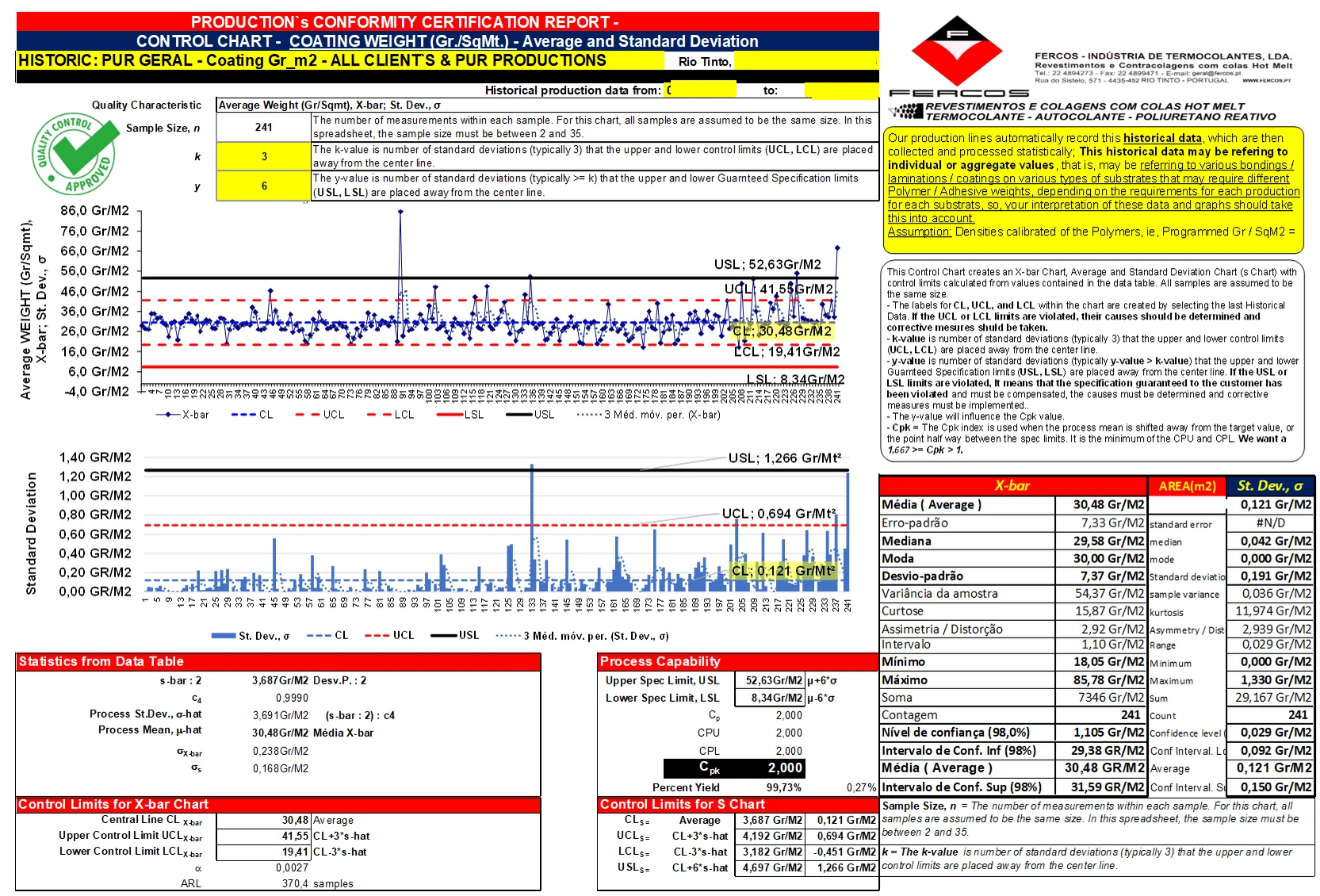
PUR coating weight, on a control chart
FERCOS measures the coating weight in each production run and tracks it on a control chart, with the mean, the control limits and the specification limits. The system also records temperatures, pressures, tensions and the adhesive lot, per customer and per production run.
PUR on the line


Frequently asked questions
How long does PUR take to cure?
First strength comes as it cools. Full chemical cure carries on for 24 to 72 hours. Allow for that time before stressing the material.
Does PUR resist heat better than thermoplastic hot melt?
Once cured, yes. It cross-links and stops softening with heat, unlike EVA and polyolefin. Copolyamide also resists heat well. Tell us the temperature your product has to withstand.
Can a PUR coating repel water?
It can. A PUR coating can give water repellency. Tell us the level you need.
Which materials does PUR not bond?
Polyethylene, polypropylene, PTFE and silicones, or only with difficulty. If in doubt, we test with your material first.
Does PUR contain solvents?
No. It is a 100% solid adhesive, with no solvents or water base, of EU origin.
Request a quote for your PUR laminate
Tell us the materials to bond or the material to coat, the roll width, what the finished product has to withstand (heat, water, washing) and the quantity. You can attach data sheets and specifications.
Request a quote